
Why reduce the content?
The latest version of the Global Angelman Syndrome Registry builds on years of insight from families, clinicians, researchers, industry, and practical registry use.
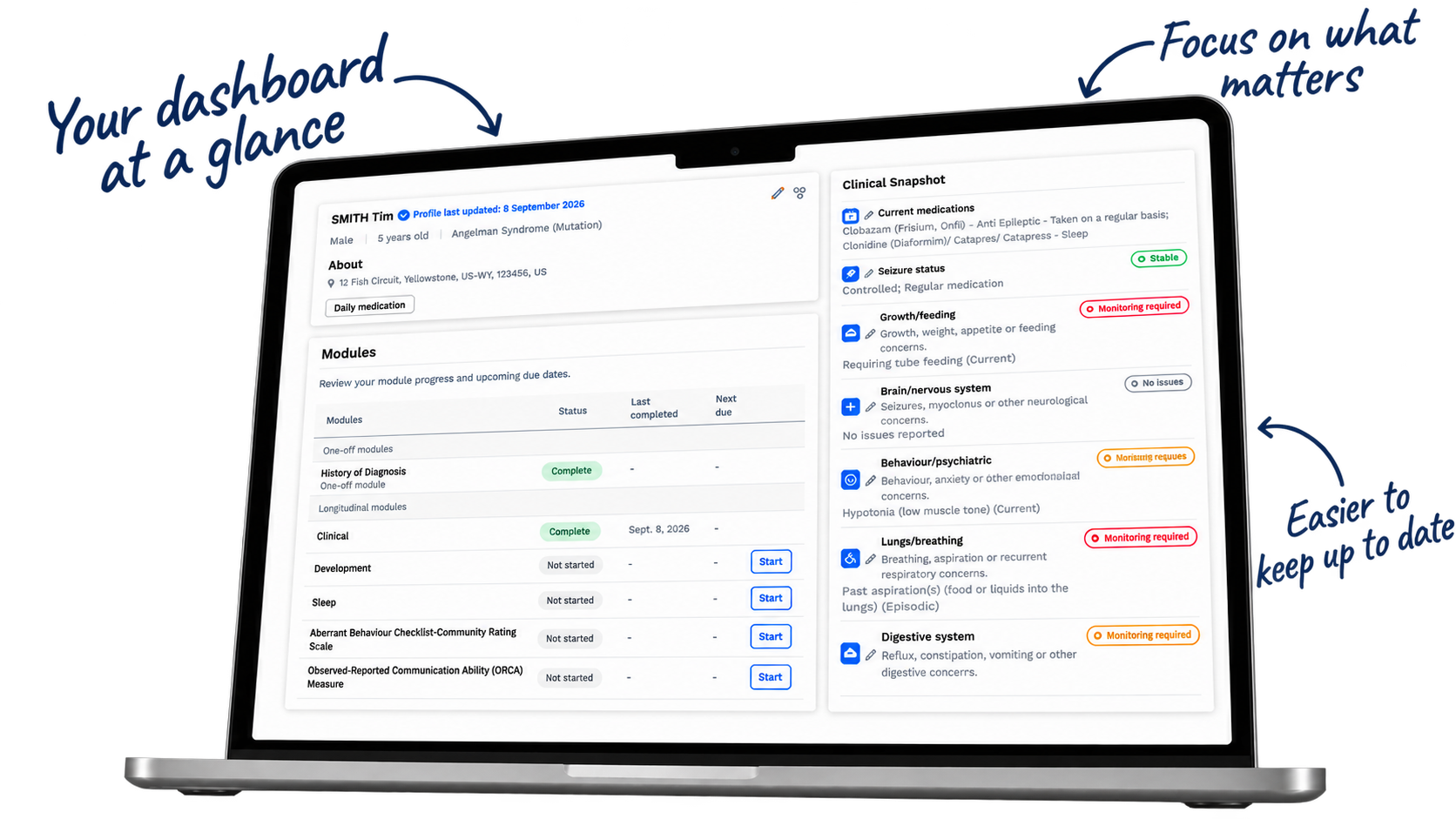
This redesign reflects an important shift: from collecting everything possible toward collecting the right information, in the right way, from the right people. We’re committed to making participation easier and more meaningful for every family involved.
We conducted a comprehensive review with key stakeholders (comprising of clinicians, researchers, industry and caregivers), systematically categorising each registry item as “Keep”, “Archive”, or “Change”.
- Archive – data that has fulfilled its purpose or is now unnecessary to collect moving forward.
- Change – data requiring refinement, clarification, or improved collection.
The goal was to collect more valuable, meaningful data, AND to reduce the ask of caregivers
What we learned from a decade of data collection
One of the key questions we asked throughout the review was:
Who can answer this question best?
Over time, we saw that certain information is critical when recorded directly by caregivers and individuals with Angelman syndrome. Families witness daily functioning, behaviours, sleep patterns, communication, gastrointestinal health, quality of life, and long-term changes in ways that clinical visits struggle to capture.
Other information is best collected accurately and consistently by clinicians, health systems, or structured assessments.
We also identified areas where:
- The data had stabilised and was unlikely to shift significantly, even with more responses.
- Questions had inconsistent or unclear results.
- Items no longer reflected Angelman-specific priorities.
Reducing Burden While Improving Quality
A major priority of the redesign was reducing caregiver burden.
Registries should not increase families’ workload or repeatedly request non-essential information.
To improve usability and data quality, we clarified question by:s
- Convertingfree-text responses into structured selectable options where appropriate
- Removing duplicate questions
- Retiring low-value or rarely used questions
- Aligning collection practices more closely with modern privacy and data minimisation principles, including GDPR considerations
- Focusing on collecting data that is actionable, clear, and meaningful for research and therapy readiness.
The result is a concise, focused registry that supports completion, participation, and improved data quality.
What Happens to Archived Data?
Archived data is not being deleted and will always remain safe and accessible for future research.
We intend to increasingly release parent-facing summaries and reports based on archived datasets, so everyone can better understand what the global Angelman syndrome community data shows over time.
Building a Registry That Evolves
Rare disease registries must continually evolve.
As therapies move closer, clinical trials expand, and healthcare systems evolve, the questions we need to ask will change too.
The Global Angelman Syndrome Registry will continue to adapt, guided by what families, researchers and clinicians need from it.
Our goal remains the same: to ensure real-world data supports research, future therapies and better outcomes for people with Angelman syndrome and their families.
If you are having trouble logging into your account, or cannot remember the email you signed up with contact curator@angelmanregistry.info.